Showing posts with label Online media. Show all posts

Thursday, January 14, 2010

Not Cool, Zeus. Not Cool. (Part One)


I don't pretend to know my way around the very confusing Hedge Maze of Factors Contributing to NBC's Unhappy Situation. But here I go, hacking into anyway! Let's start with a quote from the Media Decoder blog at nytimes.com:
The problem is not disclosure, or jokes, but the facts themselves. There are some things even the best communications strategy can’t fix, and this is one of them: angry talent standing in front of a pile of smoking rubble that used to be a programming schedule.
By nature, the best of the talent, as generally creative (read: inventive) folks, can adapt to changing landscape more efficiently than the administration. Shows, whether broadcast as a radio production or streamed directly into our contact lenses, need to be written, directed, performed, edited, designed, and any other number of artistic-past-tense-verbed. The job of the networks is on shakier ground. How will advertising fit in, and to what extent? What are the administrative needs and costs of producing and distributing the product? How do you measure and track the audience when they consume their media in multiple, shifting, flighty ways?

I don't envy the Jeff Zuckers or Jeff Gaspins of the world their jobs. But they get paid a lot of money for that responsibility, so they need to nut up (or ovary up, in some cases) and do their jobs. The industry has static (ref: the plot of "Singing in the Rain," James Cameron for the last fifteen years). The whole impetus of movie-making and broadcasting is to continue the narrative. That goes for the stories as well as the technology involved, the union rules, the censorship requirements, the audience preferences, etc.

When Charlie Chaplin finances, writes, produces, directs, acts in, and composes original music for his own work, you have a perfect storm. A gifted multimedia artist who is also an effective administrator produces a quality product that can perform as intended. But that isn't a sustainable model--the business is too big and (non-Chaplin) talents are too narrow. Networks and their executives need to be more nimble--more investments like Hulu.com and more nuanced understanding (and communication) of the new map being drawn by the combination of streaming/DVR numbers and traditional ratings, plus any other matrices by which they judge "success."

The talent (in this case, the comedians) have another leg up besides their adaptability. You can't be a good comic without being a good communicator. And as Media Decoder said, the problem is definitely not the jokes (weeeeeell, except for in Leno's case), however; in a meta-but-predictable twist, the problem has become the joke. If you've been watching, all the late-night monologues have been directing some level of vitriol to the network or executives over the last couple days (especially Conan). Comedy done right can be a verbal panic room--powerful self-defense. That goes for stand-up and the written word, and if you haven't read Conan's letter yet, you must--it's a great and honest in to what he is going through, and a sterling example of how to make your point, capture hearts and minds, and not be a dick.


More to come...

Saturday, December 6, 2008

Today in Python

On November 13, the ArtsBeat blog on the New York Times posted this piece about how the dead parrot skit actually has its origins (whether the Pythons intended it or not) in a Greek book of jokes from the 4th century A.D. Titled "Philogelos," which you root-word fiends know means "lover of laughter," the book contains "age-old jokes about drunks, gluttons, halitosis, and misogyny." "Philogelos" has recently been translated into English, and in a neat twist on collaborative media, the translator (William Berg) and a British comic (Jim Bowen) have published an online multimedia book, which you can find here. The piece of interest for us in Python context, though, is the joke in which a man attempts to return a dead slave to the man who sold it to him. Definitely crueler, I think, but then that's ancient Greece, right?

Keeping in mind that there really is no new way to be funny, let's consider an article published yesterday in the New York Times, with the first line, "Is there life left in the dead parrot sketch?" Eric Idle has been the banner-carrier for the troupe since 1983, when "The Meaning of Life" was released. He's released books, DVDs, even a Broadway show (starring Clay Aiken and closing January 18th in NY! See it now! Or don't, it really wasn't that great...just go watch "Holy Grail" again). Now, Idle's assuring us that Monty Python can still be an active generator of content and discussion, even if Graham Chapman died in the eighties, and Michael Palin is off getting enough foreign policy experience to share with another Palin who might need it one day, and John Cleese is working on a stage musical adaptation of "A Fish Called Wanda," and Terry Gilliam is struggling to finish "The Imaginarium of Doctor Parnassus" without Heath Ledger, and Terry Jones is...god, what is Terry Jones doing? Well, Wikipedia says he's been directing plays in Portugal. Good for him.

Idle has launched a Web site, pythonline.com, that features Python YouTube videos, discussions, and other internetty things. It has been in beta-testing since the spring and officially goes live at the end of the month. I've perused it, and I think I agree with Robert J. Thompson, the founding director of the Bleier Center for Television and Popular Culture at Syracuse (and, evidently, a "huge Python fan" in high school): "When you can get a Monty Python screensaver, it ceases to be what Monty Python was." Python humor is all about them specifically NOT ingratiating themselves with the public--they were trying to be funny for each other and working their absurd Oxford/Cambridge comedy roots (which, yes, do exist; Cambridge Footlights Players alumni also include Douglas Adams, Sasha Baron Cohen, Stephen Fry, Hugh Laurie, Emma Thompson...the list goes on). 

I disliked "Spamalot" for the same reason--it might make me a snob, but I want my comedy to challenge or surprise, rather than pander to the lowest common punchline. I want my strange Terry Gilliam illustrations to make NO SENSE and yet still form a cohesive narrative, not be icons that say "CLICK HERE TO GET A LIFE." And I want my Eric Idle to be not a web mogul but someone who dresses like this to meet the Prince:

That's more like it.

Thursday, July 3, 2008

Dr. Horrible, Part II

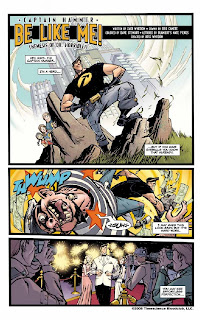
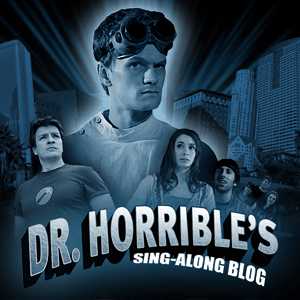
The Whedon family is clearly a talented bunch. In preparation for Dr. Horrible on July 15, I present to you...Captain Hammer:

Tuesday, July 1, 2008